
Choosing textile machinery for Bangladesh Cone Packing
Plan textile machinery for Bangladesh spinning mills with practical guidance on cone wrapping, sack or carton packing, labour, layout and investment.
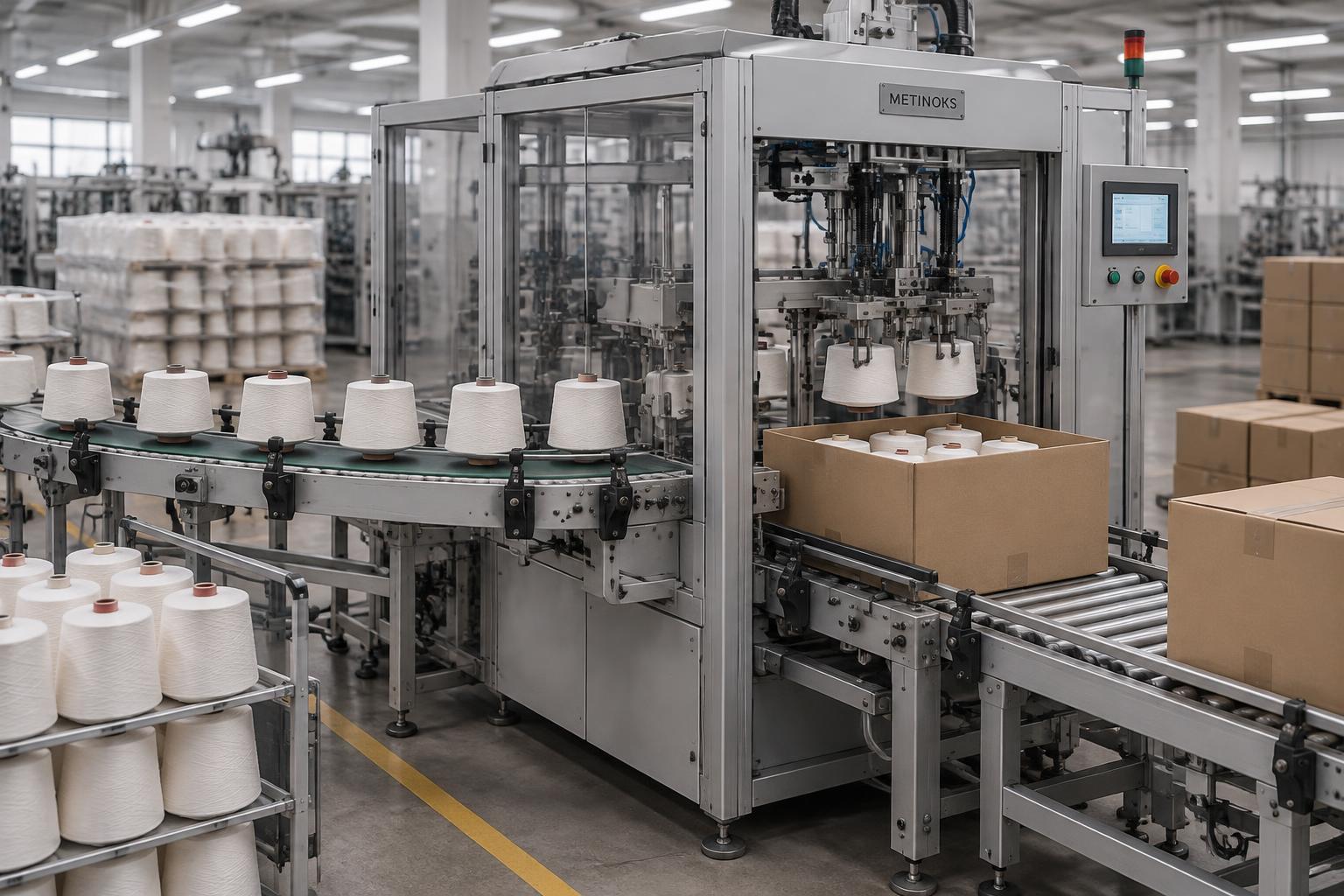
Choosing textile machinery for a Bangladesh spinning mill starts with the buyer’s packing specification, the required dispatch output and the available floor space. For cone packing, Metinoks Jet Pack wraps individual cones before a selected sack or carton route, helping mills organise protection and handling around their actual production needs.
Specify textile machinery from dispatch backwards
Start with the finished package rather than an equipment list. A mill supplying yarn to knitting or weaving units may have different handling requirements from a mill preparing export consignments. Confirm whether each order requires sacks or cartons, how cones must be separated, and what identification must remain visible at dispatch.
A line ends with either Jet Bag for sacks or Jet Box for cartons—not both. Establish that choice before planning conveyors, operator positions and pallet handling. It determines the downstream capacity and much of the packing-floor layout.
Prepare a requirement sheet covering:
- Cone dimensions, yarn types and lot identification practices.
- Cones per finished package and the buyer’s packing arrangement.
- Sack or carton specification and pallet requirements.
- Dispatch targets by shift, including product changes.
- Available space for incoming cones, consumables and finished goods.
- Existing labour assignments and manual handling points.
This gives the machinery discussion a practical foundation without assuming that every mill needs the same configuration.
Jet Pack: protection at the individual cone
Jet Pack is the yarn packing machine at the centre of this decision. It wraps each cone in polyethylene film without touching the yarn and without adhesive. Excess film is tucked into the cone, sealing the yarn from air.
The verified operating figures are about 4 seconds per cone and 900 cones per hour. Jet Pack has a power specification of 1.5 kW, weighs 800 kg and uses film with a width of 800–1000 mm. These figures support initial planning, but the full line must be assessed against its selected downstream equipment.
For a Bangladesh packing floor, the practical concern is keeping wrapped cones away from unnecessary exposure during subsequent handling. Film wrapping should be considered alongside clean transfer areas, suitable outer packaging and covered storage—not as a substitute for them.
Dust and moisture need separate checks
Cone wrapping provides a protective barrier, but it does not establish a verified moisture-performance rating for an export consignment. Check incoming cones, cartons and sacks for dampness before packing. Agree packaging acceptance criteria with the buyer and review storage conditions during the monsoon.
For export orders, assess the complete package through handling and storage trials. Do not assume that individual film wrapping alone addresses every condition encountered between the mill godown and destination unloading.
Match cone feeding to the selected packing route
Jet Store provides a buffer ahead of packing. It holds 120 cones, is loaded 12 at a time and has a stated capacity of 900 cones per hour. Its power specification is 1 kW and its weight is 400 kg.
The buffer helps organise feeding, but it still needs a replenishment plan. Decide who brings cones to the loading position, how lots remain separated and where the next batch waits. A buffer should not become an unmarked mixing point between yarn lots.
Sack packing with Jet Bag
Jet Bag fills individually bagged cones into single- or double-layer sacks. Its specified sack dimensions are 600–1300 × 600–1400 mm, and its capacity is 700 cones per hour. The operator sews the sack mouth after filling.
Include sewing and removal of filled sacks in the labour assessment. Automating filling does not remove the need to organise closure, inspection and transfer to the palletizing area.
Carton packing with Jet Box
Jet Box erects the carton, applies bottom tape, arranges cones in a pattern such as 4×3, adds separators and applies top tape. Weighing and labelling are optional. Its specified capacity is 500 cones per hour.
Carton dimensions are 400–600 × 500–800 × 350–700 mm, with board thickness up to 8 mm. Check the proposed carton and separator arrangement against the buyer’s requirement before finalising the machine configuration.
A 900-cone-per-hour wrapping machine does not make the carton route a 900-cone-per-hour line. Plan dispatch output around the selected downstream process and the time needed for routine interventions.
Build the layout around people and materials
Spinning mill automation works more effectively when material movement is clear. Draw the route from incoming cones to wrapping, then to the chosen outer package, palletizing and finished-goods storage. Mark where operators replenish film, sacks, cartons, separators and tape.
Keep consumable storage accessible without obstructing machine access or pallet movement. Allow room to inspect packages and isolate any item requiring rework. Exact access and clearance requirements should be agreed during project layout planning rather than guessed from the machine’s weight or output.
For the sack route, position the sewing task so filled sacks do not accumulate in the transfer area. For the carton route, consider how carton blanks and separators reach the machine without repeated crossings of the finished-package path.
Also review housekeeping responsibilities. Film offcuts, loose packing materials and yarn dust need a defined removal routine. A tidy packing area supports inspection and reduces unnecessary handling around the equipment.
Plan palletizing and dispatch as part of the line
Jet Pal palletizes cartons or sacks. It accepts pallets up to 1200×1200 mm and a stacking height of 2500 mm. Tare and gross weighing are optional, and the gantry palletizer handles up to 10 packages per minute.
Package rate and cone rate are different measures. Convert the selected packing arrangement into finished packages before assessing whether palletizing matches the upstream process. The number of cones in each sack or carton matters to this calculation.
Jet Stretch stretch-wraps palletized cartons or sacks. Wrap-count settings and a touch panel are optional. Confirm the required wrapping arrangement with the pallet pattern and buyer’s dispatch specification.
Pallet wrapping does not correct an unsuitable carton or unstable stacking arrangement. Review the complete load, including pallet condition, package alignment and final identification, before treating it as ready for the finished-goods godown.
Assess investment using mill records
A useful ROI review compares the present packing method with a clearly defined proposed workflow. Avoid applying an assumed labour-saving percentage or calculating payback from nameplate speed alone.
Use records from your own operation:
- Labour time for wrapping, filling, closure and pallet handling.
- Film, tape, sack, carton and separator consumption.
- Repacking caused by damaged or incorrectly prepared packages.
- Waiting time between winding output and packing.
- Changeovers, housekeeping and consumable replenishment.
- Finished packages accepted for dispatch per shift.
Separate work eliminated from work reassigned. Operators may still replenish consumables, sew sacks, inspect packs or move finished pallets. Likewise, listed machine power is not a complete electricity-cost estimate; actual consumption depends on operating conditions and the configured line.
For buyers evaluating Turkish textile machinery, Metinoks Mekatronik designs and builds its machines in-house in Çorlu / Tekirdağ, Türkiye. On-site installation and commissioning are provided. Discuss the intended material flow and operating responsibilities during project definition.
FAQ
Should our spinning mill choose sacks or cartons?
Follow the buyer’s packing specification and handling requirements. Jet Bag serves the sack route, while Jet Box serves the carton route. Define one endpoint for the proposed line before reviewing layout and output.
Will Jet Pack remove all manual packing work?
No. It automates individual cone wrapping, but the overall labour requirement depends on feeding, consumable replenishment, inspection and downstream handling. With Jet Bag, the operator still sews the sack mouth.
Is cone wrapping enough for monsoon storage and export?
Do not assume so. Review dry packing materials, storage conditions and the complete outer package. Confirm the buyer’s acceptance criteria and assess the finished package under the handling conditions relevant to your orders.
What information should we send for a quotation?
Send cone details, the selected sack or carton specification, required dispatch output, pallet requirements and a packing-floor layout. Include present handling steps and labour assignments so the proposal addresses the actual workflow.
To discuss a suitable configuration, share your packing requirements with Metinoks Mekatronik and request a quote at info@metinoks.com.tr or +90 282 673 25 92.