
Jet Box cone packing machine: Planning Carton Output
Explore the Jet Box cone packing machine for yarn carton preparation, cone arrangement, separators and sealing, with practical mill planning guidance.
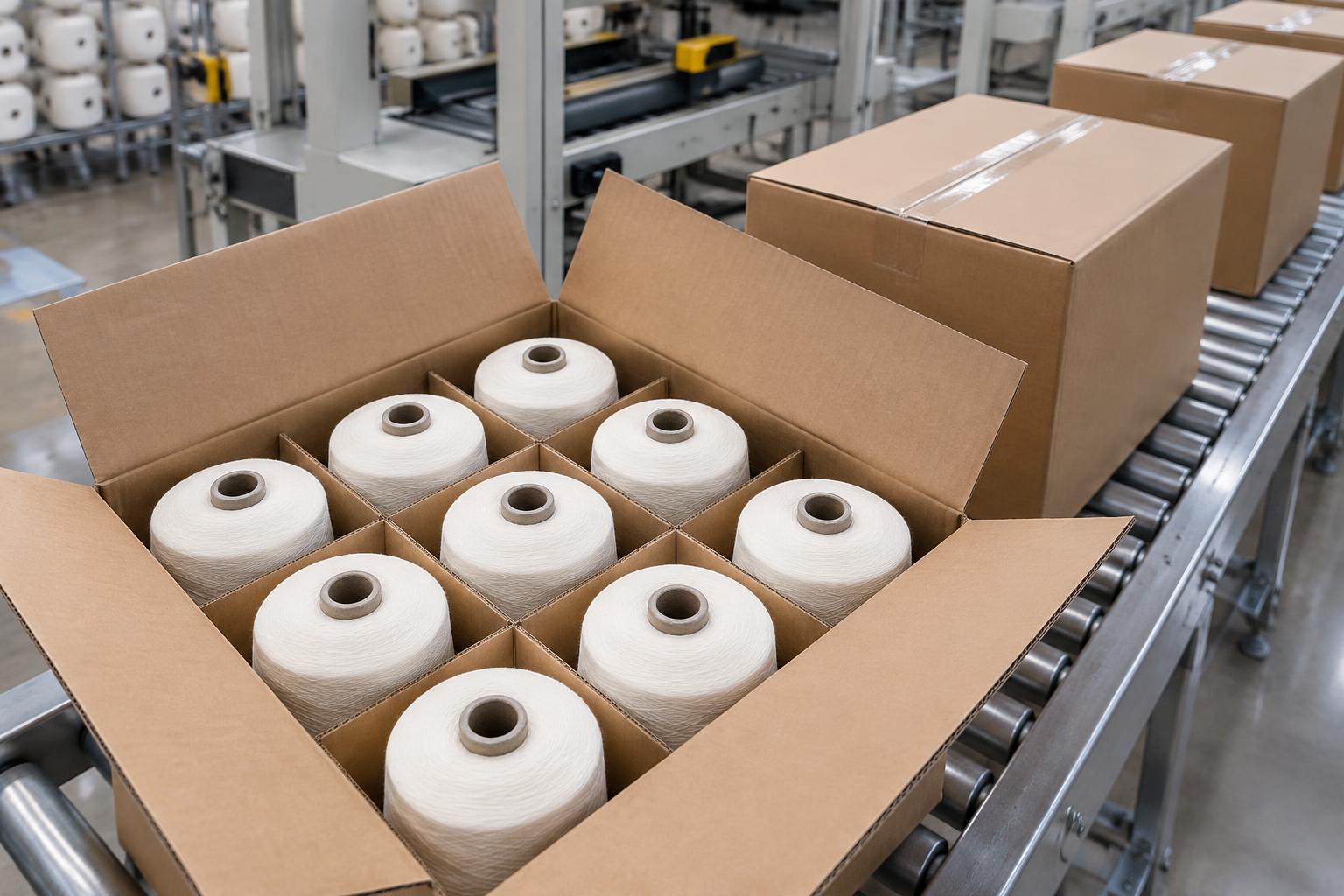
The Jet Box cone packing machine from Metinoks Mekatronik prepares cartons, arranges yarn cones, adds separators and seals the filled carton. With a listed capacity of 500 cones per hour and optional weighing and labelling, it serves spinning mills choosing a carton-based packing route.
For production managers, the primary assessment is how that automated packaging sequence aligns with the mill's cone formats, carton specifications and dispatch schedules. A practical evaluation begins with the specific packing recipe and follows the physical material flow from yarn staging through to pallet handling.
How the Jet Box cone packing machine works
Jet Box integrates several essential carton-packing operations into a single continuous sequence. The unit erects flat carton blanks, applies adhesive tape to the bottom flaps, arranges yarn cones inside the cavity, places protective separators and secures the top flaps with tape.
The cone arrangement can follow several configurations, such as a 4×3 pattern. Mill engineers should treat this arrangement as an operational example rather than an unchangeable standard. The exact positioning and layer arrangement must be evaluated against the physical dimensions of the yarn cones and the interior space of the shipping carton before establishing final equipment settings.
The standard operational sequence comprises several functional stages:
- Carton erection: forming square cartons from flat corrugated board.
- Bottom taping: applying sealing tape along the bottom centre seam to prepare the base for filling.
- Cone arrangement: grouping and placing cones inside the box according to the agreed packing pattern.
- Separator insertion: introducing intermediate divider sheets between cone layers or groups.
- Top taping: folding top flaps and applying adhesive tape to close the container.
- Optional weighing and labelling: integrating weighing scales and print-and-apply labelling units onto the discharge section.
When organizing textile packaging, plant engineers should differentiate carton preparation from individual package wrapping. Jet Box executes the carton-erecting, cone-grouping and box-sealing cycle; individual cone wrapping using PE film is handled separately by the Jet Pack unit.
Check carton specifications before discussing machine output
Evaluating an automated cone packing machine requires looking closely at how carton dimensions, board thickness and package recipes align. Nominal processing speed represents only one operational factor during planning.
Published Jet Box technical specifications
- Carton dimensional range: 400–600 mm width × 500–800 mm length × 350–700 mm height.
- Maximum board thickness: corrugated board up to 8 mm.
- Listed mechanical capacity: 500 cones per hour.
- Connected electrical power: 1.5 kW.
- Total machine weight: 1,200 kg.
- Available options: gross/tare weighing modules and automatic labelling.
When providing carton measurements to engineering teams, mills must indicate which specific measurement corresponds to width, length and internal height. Submitting three bare numbers without an engineering drawing or flap diagram can cause misalignment during line layout design.
A corrugated box that fits within the published dimensional boundary must also be verified against the total cone volume. The cone base diameter, tip diameter, cone height, tare weight and required divider pads must be calculated together. This approach establishes a complete packaging recipe rather than relying solely on exterior box dimensions.
Prepare a complete packing recipe for technical review
Mill technical teams should document exact cone formats, required cone counts per box, corrugated board grades and separator materials. Spinning operations producing multiple yarn counts or cone formats should highlight the primary formats that dominate daily dispatch.
Clarify whether integrated gross weighing or automatic barcode labelling is needed on the boxing line. Because weighing and labelling are optional Jet Box features, plant planners must specify them early in project discussions rather than presuming they are included in basic machine configurations.
Plan a carton route from cone wrapping to pallet handling
When configuring a carton-based packaging route, the cone packing machine operates within a broader sequence of dedicated handling units. A Metinoks packaging line terminates in either a sack packaging route using Jet Bag or a carton route using Jet Box; the system does not combine both methods on a single packing line.
Every linked machine serves a distinct role in the process. Their published throughput figures must be assessed in context rather than treated as identical measurements across the plant floor.
Upstream yarn buffering and protective wrapping
Upstream cone staging often begins at the Jet Store buffer. This unit holds up to 120 cones and receives them in groups of 12 at a time, providing a buffer capacity of 900 cones per hour. Its drive system uses 1 kW of electrical power, and the machine structure weighs 400 kg. Mills must determine how yarn trolleys or conveyor infeeds will deliver wound bobbins to this buffer section.
From staging, yarn cones advance to Jet Pack for individual wrapping. Jet Pack covers each cone in protective polyethylene film without using adhesives and without making surface contact with the wound yarn. The unit tucks surplus film neatly into the inner cone tube to seal the yarn against ambient air. Jet Pack processes a cone in approximately 4 seconds, achieving a rated throughput of 900 cones per hour on a 1.5 kW drive system with an 800 kg structure, utilizing film roll widths between 800 and 1000 mm.
Because Jet Pack wraps bobbins at up to 900 cones per hour, it easily keeps pace with the downstream Jet Box. However, higher upstream throughput does not increase the rated Jet Box boxing speed of 500 cones per hour.
Downstream palletizing and stretch wrapping operations
Once cartons are sealed by Jet Box, they transfer to downstream handling. Metinoks provides the Jet Pal gantry palletizer for stacking finished cartons onto transport pallets. The gantry system handles up to 10 packages per minute and accommodates pallets measuring up to 1200×1200 mm with total stack heights up to 2500 mm. Integrated tare and gross pallet weighing is available as an option.
Pallet loads then advance to Jet Stretch for outer wrapping. Jet Stretch wraps palletized cartons or sacks with stretch film, with touch-screen controls and custom wrap-count programming available as project options.
When calculating line capacity, note the difference in engineering metrics: Jet Box measures speed in cones per hour, whereas Jet Pal measures throughput in finished packages per minute. Converting these values depends entirely on the number of cones packed per carton.
Turn the packing specification into a purchasing enquiry
Specifying an industrial cone packing machine requires turning production routines and container dimensions into clear engineering data. Providing comprehensive details ensures technical proposals match actual daily production demands.
Include the following operational details in technical enquiries:
- Yarn cone formats: outer base diameter, cone taper, package height and bobbin weights.
- Carton data: dimensional drawings indicating length, width, depth, board thickness (max 8 mm) and flap styles.
- Internal separators: material composition, thickness and insertion pattern for each yarn format.
- Target production rates: required packed cone volume per shift and total daily packing operating hours.
- Ancillary options: specifications for integrated carton weighing and shipping label application.
- Pallet parameters: pallet base dimensions (up to 1200×1200 mm), target stack height (up to 2500 mm) and weighing preferences.
- Plant layout: floor space constraints, infeed heights and access pathways for pallet removal.
Metinoks Mekatronik designs and builds all machinery in-house at its 2,000 m² facility (1,000 m² indoor and 1,000 m² outdoor) in Çorlu, Tekirdağ, Türkiye, supported by an engineering team of 25 staff. Founded in 2008 by Metin Çakıcı, the company provides on-site installation and commissioning for complete textile packaging installations.
FAQ
What carton dimensions are supported by Jet Box?
Jet Box accommodates carton sizes ranging from 400–600 mm in width, 500–800 mm in length and 350–700 mm in height, with corrugated board thickness up to 8 mm.
Does Jet Box wrap individual yarn cones before boxing?
No. Jet Box manages carton forming, cone arrangement, separator insertion and top taping. Individual PE film wrapping without adhesive is performed upstream by Jet Pack.
Are weighing and labelling units included as standard equipment?
Carton weighing scales and automatic labelling devices are optional features for Jet Box and must be specified during the project consultation.
Can Jet Box discharge directly to a palletizer?
Yes. Sealed cartons from Jet Box can feed directly into a Jet Pal gantry palletizer, which handles up to 10 packages per minute on pallets up to 1200×1200 mm.
Discuss your carton-packing requirements
To review technical layouts or request project quotations for Jet Box, contact Metinoks Mekatronik with your carton drawings, cone formats and production targets. Reach the engineering team directly at info@metinoks.com.tr or call +90 282 673 25 92 to configure an end-of-line carton packaging system.