
Before the carton sealing machine: Jet Pack Cone Wrapping
Explore how Metinoks Jet Pack wraps yarn bobbins before the carton sealing machine stage, securing individual packages for downstream mill boxing.
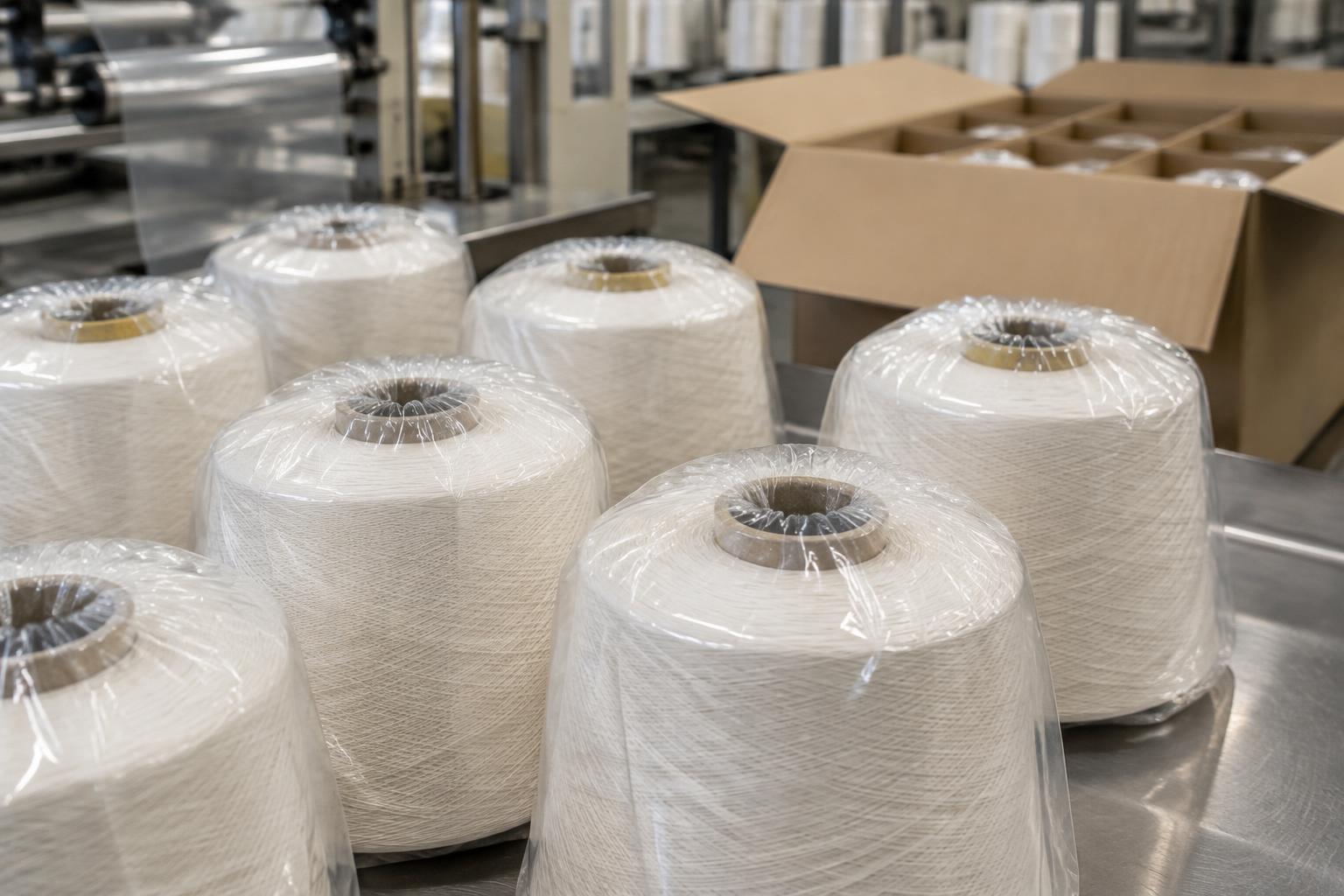
Jet Pack protects individual yarn cones before they reach the carton sealing machine stage of a spinning mill’s packing process. It wraps each cone in polyethylene film without touching the yarn or using adhesive, while Metinoks Jet Box handles carton erection, cone arrangement and bottom and top taping on the carton-packing route.
For production managers, the distinction matters: protecting the yarn package and closing the shipping carton are separate operations. Specifying them together starts with understanding what each stage does, which packing format the mill needs and where throughput must be balanced.
What happens before the carton sealing machine?
A finished cone needs individual protection before it becomes part of a shipping unit. Carton closure secures the outer container; it does not perform the same job as wrapping the yarn package itself.
Jet Pack – Automatic Yarn Bobbin Packing applies PE film around each cone. The wrapping process does not touch the yarn and uses no adhesive. Excess film is tucked into the cone, sealing the yarn from air.
This makes Jet Pack the individual-cone wrapping stage, not a carton taping unit. On a carton route, Jet Box performs the subsequent boxing operations. Keeping these functions distinct helps mill teams prepare a specification that covers both yarn protection and outer packaging.
Why the distinction belongs in a purchasing brief
A request for a carton sealing machine may focus on carton dimensions, board thickness and top closure. A yarn-cone packing project also needs to address the condition of each cone before boxing.
The purchasing brief should therefore identify:
- The individual-cone wrapping requirement.
- Whether the final shipping unit is a carton or a sack.
- The required output in cones per hour.
- The outer-package dimensions and arrangement.
- Any weighing, labelling or palletizing requirements.
Jet Pack: the individual-cone protection stage
Jet Pack’s verified operating figures provide a starting point for planning:
- Wrapping material: polyethylene film.
- Film width: 800–1000 mm.
- Cycle time: about 4 seconds per cone.
- Output: 900 cones per hour.
- Power: 1.5 kW.
- Machine weight: 800 kg.
The film-tucking method is central to the process. Instead of applying adhesive to close the individual wrap, Jet Pack tucks the excess film into the cone. Buyers should keep this adhesive-free wrapping operation separate from the tape used to close cartons downstream.
For a useful technical discussion, prepare representative cone details and the intended packing format. The published film-width range is a machine specification, not a substitute for checking the mill’s actual cone presentation with Metinoks.
Read the cycle figure at the right level
About 4 seconds per cone and 900 cones per hour describe Jet Pack. They should not be treated as the output of every machine in a complete packing route.
A production plan also needs to account for the downstream packing stage and the mill’s operating pattern. Separate machine ratings make it possible to identify where accumulation, operating schedules or capacity requirements need discussion before the layout is agreed.
From wrapped cones to closed cartons
For mills shipping in cartons, Jet Box performs more than top-tape application. It erects the carton, tapes the bottom, arranges the cones, adds separators and tapes the top. A cone arrangement can be, for example, 4×3; the required format should be discussed for the project rather than assumed for every order.
Jet Box accepts cartons measuring 400–600 × 500–800 × 350–700 mm, with board thickness up to 8 mm. Its listed output is 500 cones per hour, and weighing and labelling are optional.
This is why a carton sealing machine enquiry should include the full carton-handling sequence. If the mill needs carton erection, cone placement and separators as well as closure, the specification must describe those operations explicitly.
Balance wrapping and boxing capacity
Jet Pack is rated at 900 cones per hour, while Jet Box is rated at 500 cones per hour. Those figures should not be combined into a claim that the carton route produces 900 cones per hour.
For planning purposes, the lower-rated boxing stage is the capacity constraint between these two operations. Ask Metinoks to review the required production volume, packing schedule and handling between stages. Do not assume that the difference in ratings is resolved automatically.
Choose one final packing route
A Metinoks packing line ends with either sacks through Jet Bag or cartons through Jet Box—not both as consecutive packing stages.
On the sack route, Jet Bag fills bagged cones into single- or double-layer sacks. Its listed output is 700 cones per hour, and the operator sews the sack mouth. Carton taping is therefore not part of that final packing route.
On the carton route, Jet Box creates and closes the outer package. Jet Pal can then palletize cartons, and Jet Stretch can stretch-wrap the palletized cartons. These downstream functions should be considered when defining the overall project, without confusing them with individual-cone wrapping.
Prepare a practical Jet Pack enquiry
A useful enquiry connects the wrapping requirement to the mill’s dispatch format. It should give the engineering team enough information to discuss the process without relying on assumptions.
Include:
- Cone details: dimensions, yarn type and current presentation.
- Production requirement: target cones per hour and packing schedule.
- Packing route: cartons or sacks.
- Carton requirements, if applicable: dimensions, cone arrangement and separators.
- Optional functions: weighing, labelling and downstream pallet handling.
- Site information: proposed location and available space around the packing area.
Metinoks Mekatronik designs and builds its machines in-house in Çorlu, Tekirdağ, Türkiye. On-site installation and commissioning are available. Use the project discussion to establish the equipment scope and the responsibilities at each packing stage.
FAQ
Is Jet Pack a carton sealing machine?
No. Jet Pack wraps individual yarn cones in PE film. For the carton route, Metinoks Jet Box erects cartons, tapes their bottoms, arranges cones, adds separators and tapes the tops.
Does Jet Pack use adhesive or touch the yarn during wrapping?
Jet Pack wraps each cone without touching the yarn and without adhesive. It tucks excess film into the cone, sealing the yarn from air.
Will a Jet Pack and Jet Box route run at 900 cones per hour?
That should not be assumed. Jet Pack is rated at 900 cones per hour, whereas Jet Box is rated at 500 cones per hour. The complete packing plan must account for the downstream boxing capacity.
What information should we provide when requesting a quote?
Provide cone details, required output, the selected carton or sack route and relevant outer-package dimensions. Include optional weighing, labelling or palletizing requirements so the proposed scope reflects your operation.
To discuss Jet Pack for your spinning mill, request a quote from Metinoks Mekatronik at info@metinoks.com.tr or +90 282 673 25 92. Share your cone and packing requirements to start a focused technical review.