
Jet Stretch packing machine for Yarn Dispatch Pallets
Plan your spinning mill with the Jet Stretch packing machine, a pallet wrapper for yarn cones packed securely in either cartons or sewn sacks.
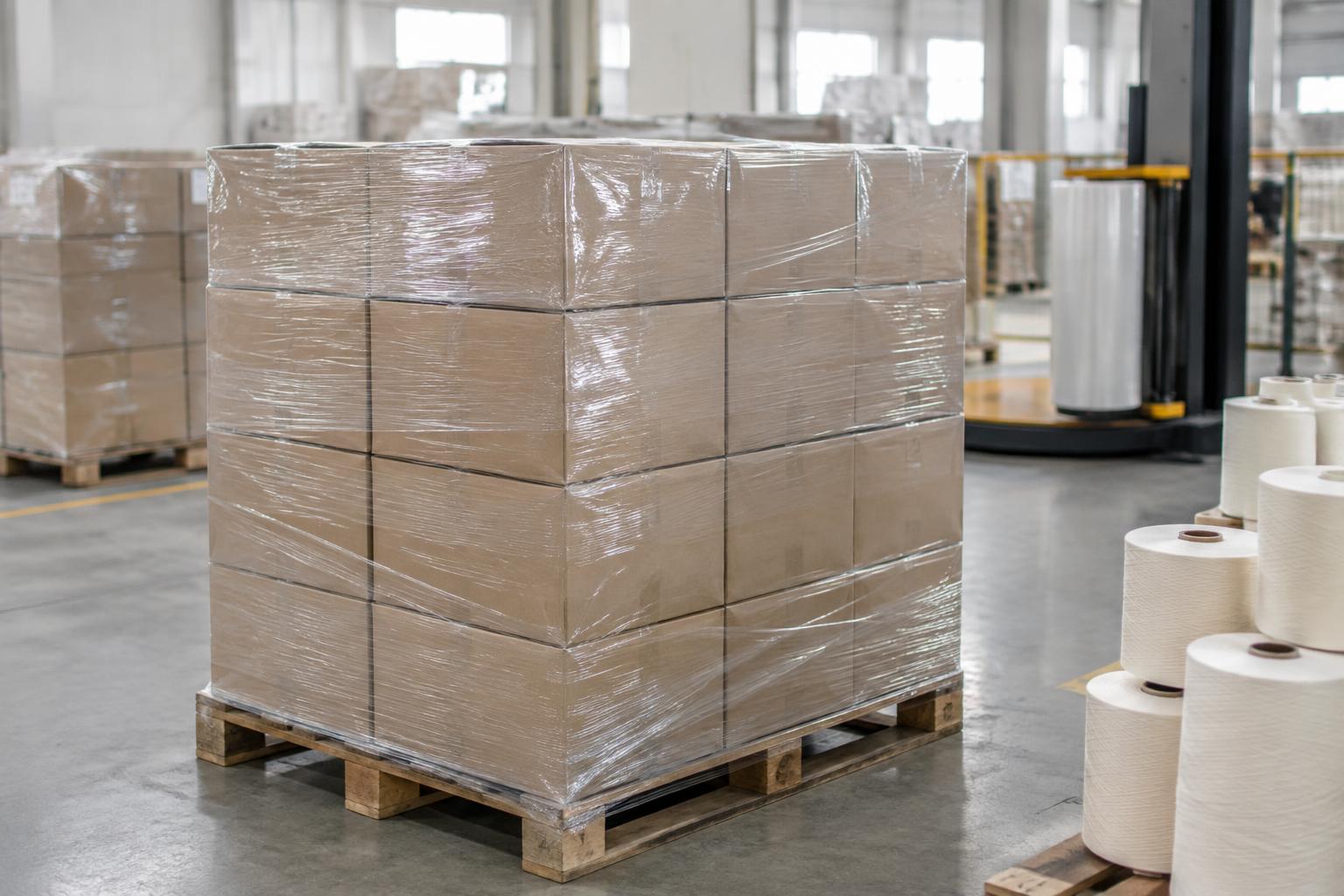
The Jet Stretch packing machine stretch-wraps palletized cartons or sacks at the final stage of a Metinoks Mekatronik yarn packing line. For spinning mills in Bangladesh, it belongs after pallet formation—not at individual cone wrapping or cone bagging. Wrap-count setting and a touch panel are optional, so these requirements should be discussed when specifying the machine.
Where the Jet Stretch packing machine fits
A spinning mill’s packing section handles several distinct tasks between finished yarn cones and dispatch. Individual cone protection, filling the outer package, forming the pallet load and wrapping that load should be treated as separate operations.
Jet Stretch works with the completed pallet load. It does not replace a yarn cone packing machine, fill sacks or seal cartons. Its role is to apply stretch film around cartons or sacks that have already been palletized.
This distinction matters when preparing a machinery enquiry. A requirement expressed only in cones per hour describes upstream production, but it does not fully describe the work arriving at the pallet wrapper. The dispatch team also needs to explain the outer package, pallet arrangement and expected flow of completed loads.
Choose the sack or carton route first
A Metinoks packing line finishes its cone-packing route with either Jet Bag for sacks or Jet Box for cartons. These are alternative outer-package routes, not consecutive stages in the same line.
Sack route for yarn dispatch
Jet Bag fills bagged cones into single- or double-layer sacks. Its specified sack range is 600–1300 × 600–1400 mm, and its capacity is 700 cones per hour. The operator sews the sack mouth.
After sack closure, the sacks can be palletized by Jet Pal, with Jet Stretch handling the subsequent pallet-wrapping stage. When planning this route, include the sewing operation in the workflow rather than treating filled sacks as immediately ready for palletizing.
Carton route for yarn dispatch
Jet Box erects the carton, applies bottom tape, arranges the cones, adds separators and applies top tape. Weighing and labelling are optional. Its specified capacity is 500 cones per hour, with carton dimensions of 400–600 × 500–800 × 350–700 mm.
Completed cartons can then move to palletizing and pallet wrapping. For this route, the quotation discussion should identify the actual carton sizes and intended pallet arrangement, rather than relying only on the cone output from winding.
Keep cone protection separate from pallet wrapping
Jet Pack and Jet Stretch act at different packaging levels. Jet Pack wraps each cone in polyethylene film without touching the yarn and without adhesive. It tucks the excess film into the cone, sealing the yarn from air, at about four seconds per cone and 900 cones per hour.
Jet Stretch wraps the palletized outer packages. It should not be specified as a substitute for that individual cone protection.
Similarly, cone bagging and bag sealing are not pallet-wrapping functions. Metinoks Jet Bag/P heat-seals the cone bag on three edges and passes it through a shrink tunnel. Its specified capacity is 600 cones per hour, with 4 kW power.
When evaluating an automated packing machine for yarn dispatch, label each requirement clearly:
- Protection or sealing of individual yarn cones.
- Filling and closing the selected outer package.
- Stacking cartons or sacks onto pallets.
- Stretch-wrapping the completed pallet load.
This keeps the enquiry focused on the operation each machine actually performs.
Plan the handover from Jet Pal to Jet Stretch
Jet Pal palletizes cartons or sacks. Its specified pallet size is up to 1200 × 1200 mm, with a stacking height of 2500 mm. Optional tare and gross weighing are available, and the gantry palletizer handles up to 10 packages per minute.
Those figures describe Jet Pal, not Jet Stretch. They should not be copied into a Jet Stretch specification as confirmed wrapper limits or performance.
For a Bangladesh spinning mill, the practical starting point is the dispatch load actually used on the floor. Record the pallet dimensions, loaded height, package arrangement and handling method. Ask Metinoks to confirm the proposed Jet Stretch configuration against those requirements.
Also review how completed loads will reach the wrapper and leave for the finished-goods area. Leave this as a layout and commissioning discussion rather than assuming a particular transfer arrangement is included.
Specify the optional controls deliberately
Configuring this pallet packing machine requires clarifying control preferences in advance. Jet Stretch offers optional wrap-count setting and an optional touch panel. These should be listed explicitly in the enquiry if the mill wants them included in the proposed configuration.
The production manager and dispatch supervisor should agree on who will manage wrapping settings and how changes between packing requirements will be communicated. This is particularly useful where different yarn lots leave the packing section in different load arrangements.
A useful enquiry checklist includes:
- Whether the line uses cartons or sewn sacks.
- Actual outer-package dimensions and pallet dimensions.
- Intended loaded pallet height and arrangement.
- Expected completed pallets during normal and busy dispatch periods.
- Whether wrap-count setting is required.
- Whether a touch panel is required.
- Available floor space and the planned pallet-handling route.
Jet Stretch cycle rate, power, film specification and supported load limits should be requested directly from Metinoks. Do not infer them from the ratings of adjacent machines.
Review capacity at the correct packaging level
Upstream machines are often discussed in cones per hour, while palletizing involves cartons or sacks. As the final packing machine on the line, Jet Stretch receives completed pallet loads. These units must be connected using the mill’s actual packing arrangement before assessing the full line.
Record how many cones go into each outer package and how many outer packages make up a pallet. Then discuss the resulting pallet demand with Metinoks, including dispatch peaks and changes between yarn lots.
A cone-packing rate alone cannot establish the required pallet-wrapping rate. Keeping those measures separate makes the technical discussion clearer and avoids treating every machine’s stated capacity as a finished-line output.
FAQ
Does Jet Stretch wrap individual yarn cones?
No. Jet Stretch stretch-wraps palletized cartons or sacks. Individual cone wrapping is the role of Jet Pack; cone bag heat sealing and shrinking are handled by Jet Bag/P.
Can Jet Stretch be used with a sack-packing line?
Yes. Jet Stretch wraps palletized sacks as well as palletized cartons. In the sack route, Jet Bag fills the sacks, and the operator sews their mouths before downstream pallet handling.
Are wrap-count setting and the touch panel standard?
Both are optional. State whether you require them when requesting a Jet Stretch quotation, and confirm the proposed configuration with Metinoks.
What should a mill send for a quotation?
Send the selected sack or carton route, package and pallet dimensions, loaded height, expected pallet flow and layout requirements. Metinoks provides on-site installation and commissioning; discuss the project requirements during the quotation process.
Discuss your final packing stage
Metinoks Mekatronik designs and builds its machines in-house in Çorlu, Tekirdağ, Türkiye. To request a Jet Stretch quote, share your mill’s dispatch-pallet details and preferred options at info@metinoks.com.tr or call +90 282 673 25 92.