
Industrial Pallet Wrapping Machine for Yarn Packaging Lines
Upgrade your mill with an automated pallet wrapping machine. Protect yarn carton pallet shipments from dust and moisture in transit to export markets.
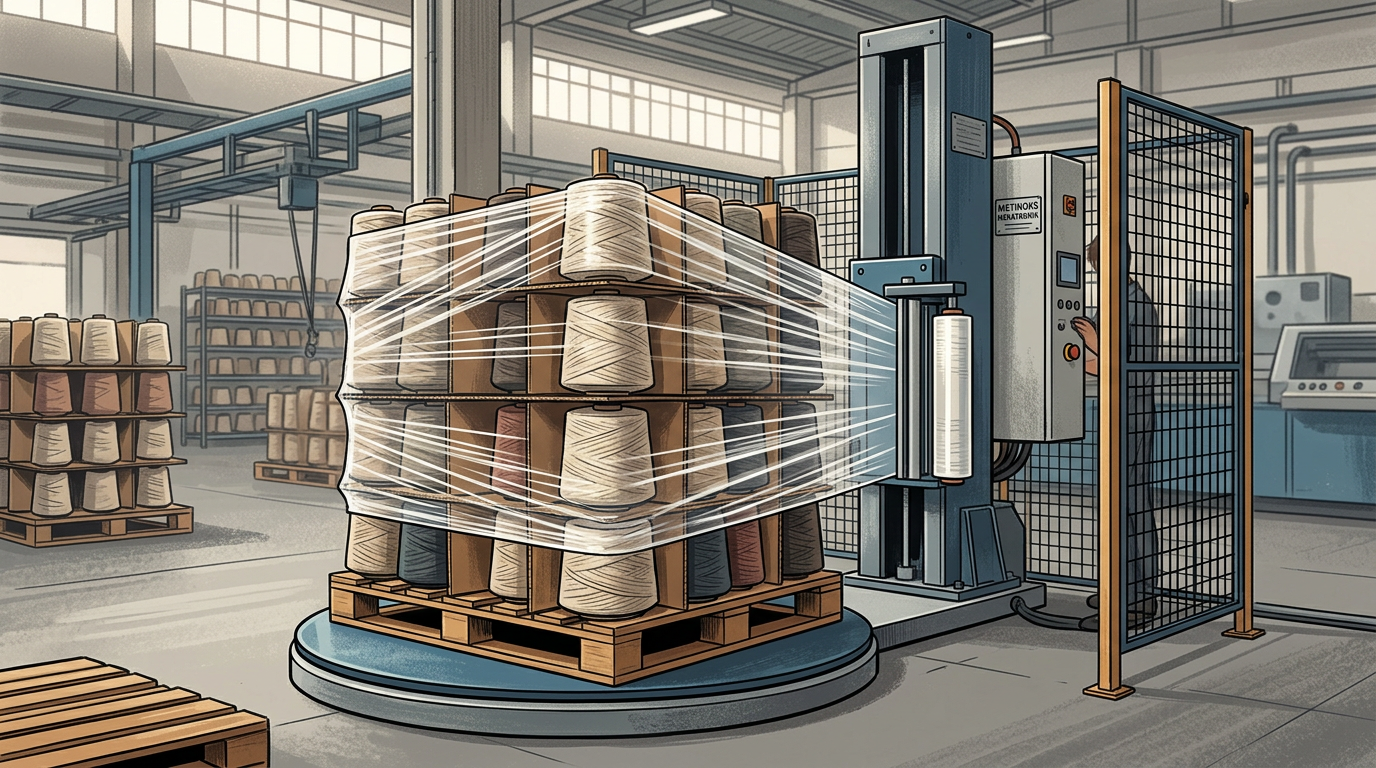
An industrial pallet wrapping machine automatically applies protective film around palletized goods to secure loads and shield yarn from dust and moisture. Metinoks Mekatronik engineers robust end-of-line packaging systems, including the Jet Stretch system, designed to secure yarn carton pallet units and bagged goods efficiently in spinning mills and industrial packaging facilities.
Selecting the Right Pallet Wrapping Machine for Textile Mills
In Pakistani textile hubs such as Faisalabad, Multan, Lahore, and Karachi, maintaining yarn quality from the winding department to the buyer's warehouse is a major operational challenge. Ambient dust, high humidity during monsoon seasons, and long-distance transport over highway networks can damage exposed yarn bobbins. Standard manual wrapping often results in inconsistent film tension, excessive film consumption, and loose loads that shift during transit.
Integrating a dedicated pallet wrapping machine at the end of your spinning or packing line resolves these packaging bottlenecks. By automating the stretch wrapping process, textile mills achieve uniform film tension across every layer, creating a tight, weather-resistant barrier around stacked goods. Whether handling heavy cotton yarn shipments or synthetic filament bobbins, automated film application prevents moisture ingress and stabilizes the load structure.
Metinoks Mekatronik, founded in 2008 by Metin Çakıcı in Çorlu / Tekirdağ, Türkiye, designs and builds complete end-of-line packaging automation systems in-house. Operating from a 2,000 m² site (1,000 m² indoor and 1,000 m² outdoor) with a specialized team of 25 staff, Metinoks manufactures robust machines tailored to the demanding continuous operations of modern textile facilities.
Securing the Yarn Carton Pallet for Export Shipments
When preparing a yarn carton pallet for sea freight or long-haul truck dispatch, structural stability is paramount. Stacking corrugated boxes filled with heavy yarn bobbins creates significant top-heavy weight. Without precise film tension from a stretch wrapping machine, upper box layers can lean or shift, risking carton crush and bobbin deformation.
The Metinoks Jet Stretch pallet wrapper addresses these transport risks directly. Operating as a crucial component of the end-of-line system, Jet Stretch applies high-tension stretch film around palletized cartons or sacks. Optional features such as custom wrap-count programming and an intuitive touch panel interface allow line operators to set specific bottom, middle, and top wrap cycles based on load height and density.
By maintaining precise film application, the machine ensures that every yarn carton pallet remains rigid and square during fork truck handling and container loading. The tightly applied film seals the load perimeter, preventing ambient road dust and moisture from penetrating the outer box walls and reaching sensitive yarn bobbins inside.
Automated Integration: From Palletizing Robot to Stretch Wrapper
A modern end-of-line packaging cell relies on synchronized equipment to process high production volumes without bottlenecks. Yarn bobbins exit the spinning or winding area and move into the Jet Store buffer store, which holds up to 120 cones and loads 12 cones at a time to feed downline equipment at a rate of 900 cones per hour while operating on a 1 kW power supply with a compact 400 kg machine weight.
Next, individual cones enter the Jet Pack machine. Jet Pack wraps each cone in polyethylene film without touching the yarn and without adhesive, tucking excess film into the cone center to seal the yarn completely from air. Jet Pack processes 900 cones per hour with a cycle time of approximately 4 seconds per cone, using a 1.5 kW motor and handling film widths between 800 mm and 1,000 mm at a machine mass of 800 kg.
From Jet Pack, the line splits depending on the facility's shipping format. It is important to note that a Metinoks packaging line ends with either sacks or cartons, never both on a single line:
- Carton Line Format: Cones flow into the Jet Box bobbin boxing machine. Jet Box erects cartons (400–600 × 500–800 × 350–700 mm, board thickness up to 8 mm), arranges cones into custom patterns (such as 4×3 double layer), places separator sheets, applies top and bottom tape, and offers optional weighing and labeling at a rate of 500 cones per hour using a 1.5 kW motor and 1,200 kg machine structure.
- Sack Line Format: Cones flow into Jet Bag, which fills individually bagged cones into single- or double-layer sacks (600–1300 × 600–1400 mm) at 700 cones per hour, where the operator sews the sack mouth. Alternatively, Jet Bag/P heat-seals the cone bag on three edges and passes it through a shrink tunnel at 600 cones per hour with a 4 kW power rating.
Once packages are filled, the Jet Pal gantry system or a palletizing robot picks cartons or sacks and stacks them onto pallets (up to 1200×1200 mm, maximum height 2500 mm). Operating at speeds up to 10 packages per minute, Jet Pal offers optional tare and gross weighing. The completed load then advances directly into the Jet Stretch machine for final wrapping.
Operational Advantages for Mill Production Managers
For mill owners and production managers evaluating equipment ROI, automation delivers practical labor savings and consistent output. Manual pallet wrapping in busy spinning mills requires significant physical labor and frequently leads to film waste through improper stretching. An automated stretch wrapping machine eliminates operator strain while optimizing film consumption per pallet.
Key operational benefits of integrating Jet Stretch into yarn packaging operations include:
- Consistent Wrap Quality: Programmed wrap counts ensure uniform tension on every yarn carton pallet, eliminating human error.
- Enhanced Environmental Protection: Continuous film wrapping shields textile products from humidity, soot, and transit dust.
- Reduced Labor Bottlenecks: Operators focus on raw material supply and quality control rather than manual film wrapping and heavy lifting.
- Streamlined Workflow: Direct transfer from the gantry system or palletizing robot to the stretch wrapper maintains line speed without manual intervention.
Metinoks Mekatronik designs and builds all machinery in-house, ensuring mechanical reliability and smooth integration across the entire line. Metinoks demonstrated its engineering capabilities at ITM 2022 in Hall 3, Stand 307A, showcasing advanced textile packaging automation tailored for international mill standards.
Frequently Asked Questions (FAQ)
How does an automated pallet wrapping machine protect cotton yarn during transport? An automated pallet wrapping machine applies stretch film under consistent tension around palletized cartons or sacks. This creates a dust-tight and moisture-resistant barrier that shields delicate yarn bobbins from ambient humidity, road dirt, and soot during long-haul transport to ports or weaving mills.
Can the stretch wrapping machine handle both sacks and boxed yarn? Yes, the Jet Stretch system can stretch-wrap palletized loads consisting of either corrugated cartons or woven sacks. However, the upstream primary packaging line itself is designed to handle either sacks (via Jet Bag) or cartons (via Jet Box), not both formats simultaneously on the same primary line.
How does the pallet wrapping machine integrate with a gantry or palletizing robot? The Jet Stretch wrapper receives stacked pallets directly from the Jet Pal gantry system or a palletizing robot via powered roller or chain conveyors. Once the palletizer completes the predefined layer pattern and height (up to 2,500 mm), the load transfers automatically into the stretch wrapping station for securing.
What floor space and power supply are required for end-of-line packing lines? Space and electrical requirements depend on the selected line configuration. Individual machines are designed for industrial efficiency; for example, the Jet Store feeding buffer consumes 1 kW, the Jet Pack wrapping unit consumes 1.5 kW, Jet Box uses 1.5 kW, and Jet Bag/P heat-seal shrink uses 4 kW. Mill engineers can consult Metinoks to finalize layout dimensions based on available floor space.
Optimizing your mill's packaging process ensures that your yarn arrives at destination markets in prime condition. Contact Metinoks Mekatronik today at +90 282 673 25 92 or via email at info@metinoks.com.tr to request a quote and explore custom end-of-line packaging solutions for your facility.